By Ctrl Editorial Team · May 21, 2026 · 8 min read
A Practical System for Reducing Operator Follow-Up Loops
A simple operating system for turning scattered asks into tracked work so follow-ups happen once, not five times.
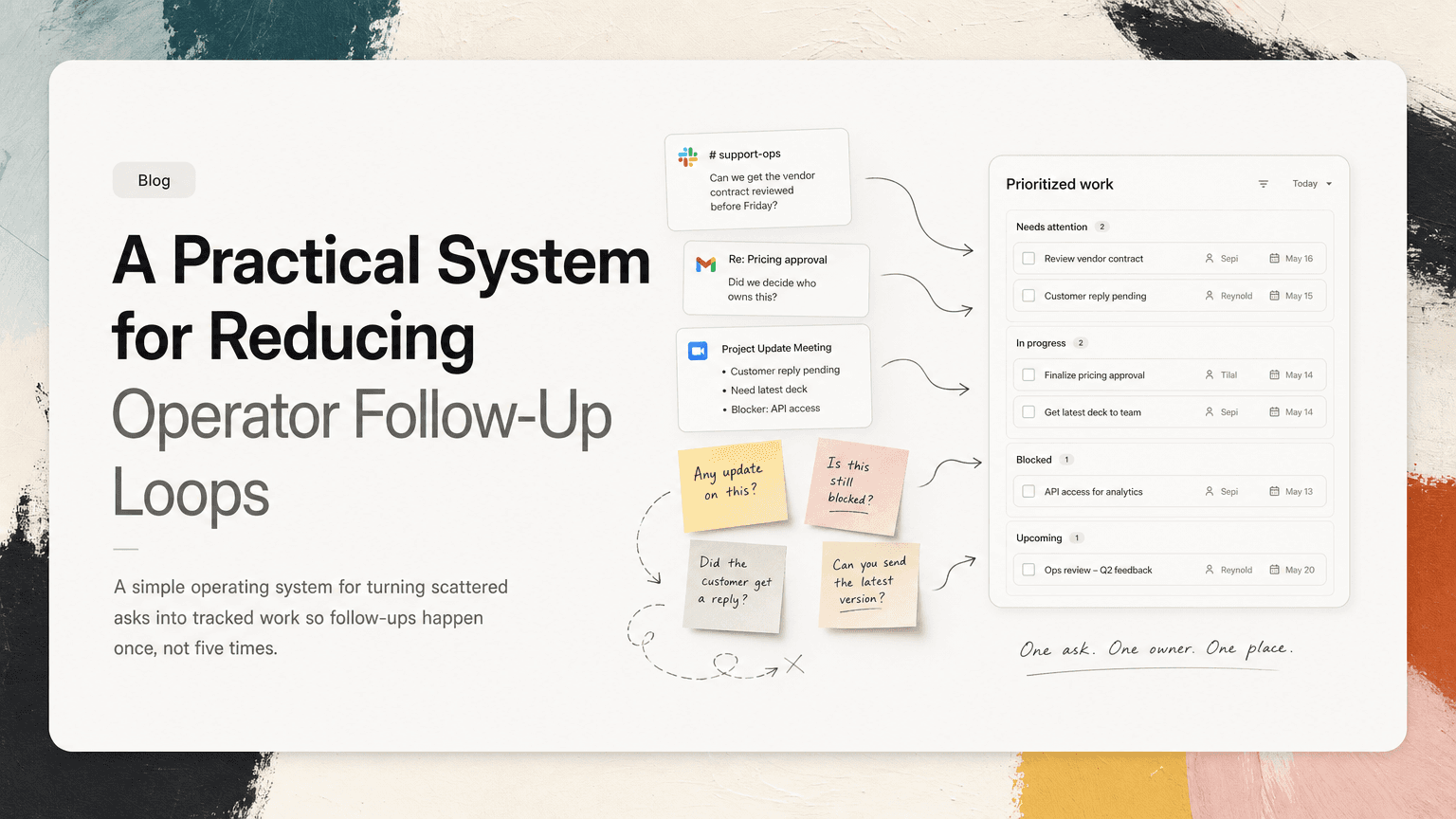
Operators spend a surprising amount of time asking the same question in slightly different forms:
- “Any update on this?”
- “Did we decide who owns it?”
- “Can you send the latest version?”
- “Is this still blocked?”
- “Did the customer get a reply?”
The problem is not that operators are bad at following up. It is that follow-up work is often created in places that are bad at holding work: Slack threads, email replies, meeting notes, hallway conversations, and half-updated docs.
When the same action item appears in three places, the operator becomes the glue. That works for a while. Then the glue becomes the system.
A better approach is to reduce the number of follow-up loops in the first place. Not by being more forceful. Not by sending more reminders. By making each ask easier to capture, assign, track, and close.
Why follow-up work repeats
Repeated follow-up usually comes from one of four breakdowns.
1. The ask was never turned into a task
Someone writes in Slack: “Can we get the vendor contract reviewed before Friday?”
Three people react with emoji. Someone says, “Yes, let’s do it.” Then the thread moves on.
There is an ask, a deadline, and probably an owner. But there is no task. So two days later, the operator has to ask again.
2. The owner is implied, not explicit
In a meeting, the team agrees to “follow up with the customer about pricing.” Everyone understands the action item differently.
Sales thinks product owns it because pricing depends on packaging. Product thinks sales owns it because the customer relationship sits there. Finance thinks they are waiting for both.
No one is being negligent. The ownership was just never made visible.
3. The context is separated from the work
A task appears in a project tracker: “Send updated rollout plan.”
Useful, but incomplete. Which customer? Which rollout plan? What changed? Was there a decision in the meeting? Is the source in Gmail, Slack, or a doc?
When context is missing, operators have to reconstruct it. That creates a second kind of follow-up: asking people to explain the original ask.
4. The same work is captured multiple times
The same follow-up might exist as:
- a Slack thread asking for an update
- a Gmail reply saying “looping back”
- a meeting note with an action item
- a task in someone’s personal list
Now the operator has to figure out whether these are the same thing or different things. If they follow up on all of them, they create noise. If they follow up on none, work may stall.
The goal is not to eliminate follow-up. Some follow-up is healthy. The goal is to stop repeating follow-up caused by unclear capture, ownership, context, and duplication.
Build a single follow-up intake habit
Operators do not need a massive workflow redesign to improve this. Start with one habit: every follow-up-worthy ask should be converted into a clear next action.
A clear next action has five parts:
- Verb: what needs to happen
- Owner: who is responsible
- Object: what the work is about
- Timing: when it matters
- Source: where the context lives
For example:
Review vendor contract redlines by Friday — owner: Maya — source: Slack thread with Legal and Ops
Or:
Send customer rollout update before Thursday’s renewal call — owner: Jordan — source: Gmail thread with Acme
This seems basic, but it changes the operator’s job. Instead of repeatedly asking, “What’s going on with this?” they can ask a sharper question: “Maya, is the contract review still on track for Friday?”
That is faster for everyone.
Separate “waiting” from “doing”
One reason operators get stuck in follow-up loops is that their lists mix tasks they own with tasks they are waiting on.
Those are different kinds of work.
Doing work
These are actions the operator is personally responsible for:
- Draft the QBR agenda
- Send the board packet
- Update the hiring plan
- Prepare the launch checklist
Waiting work
These are actions owned by someone else, but important enough for the operator to track:
- Engineering to confirm migration timing
- Legal to approve contract language
- Sales to send customer feedback summary
- Finance to update forecast assumptions
If these live in the same pile, the operator’s day becomes noisy. Everything looks equally actionable, even when half the list is blocked by someone else.
Create a separate “waiting on” view. It does not need to be complicated. Each item should include:
- owner
- expected date
- source context
- why it matters
- next follow-up date
For example:
Waiting on Priya to confirm whether the analytics migration affects enterprise dashboards. Needed before customer comms go out. Follow up Wednesday morning. Source: product launch meeting notes.
This makes follow-up intentional instead of reactive.
Use fewer, better reminders
A common mistake is to treat follow-up as a reminder problem. If something slips, add more reminders.
But more reminders can make the system worse. People start ignoring pings because they are vague or repetitive.
A good follow-up reminder should answer three questions:
- What is the decision or action needed?
- Why does it matter now?
- Where is the original context?
Compare these two messages:
Any update here?
Versus:
Can you confirm by 2pm whether the customer rollout date is still Friday? We need to finalize the support staffing plan. Original thread is here.
The second message is more useful because it reduces work for the recipient. They know what is needed, when, and why.
Operators can cut repeated follow-up by making each follow-up more complete.
Deduplicate before chasing
Before sending another reminder, check whether the follow-up already exists somewhere else.
This is especially important when work crosses Slack, Gmail, meetings, and docs.
A practical deduplication check:
- Is this the same owner?
- Is this the same outcome?
- Is this the same deadline?
- Is this referencing the same source conversation?
- Has someone already responded in another tool?
For example, you may see a Slack thread asking engineering for launch timing and a Gmail thread asking the same question for the customer update. Those may not be two tasks. They may be one decision with two downstream communications.
Instead of chasing both, collapse them into one next action:
Confirm launch timing for Acme rollout, then update both customer email and internal launch thread.
That prevents parallel follow-up chains.
Attach decisions to the next action
Operators often follow up because decisions get separated from execution.
A meeting ends with a decision: “We are delaying the beta by one week.”
But the tasks created afterward say:
- Update customer email
- Move launch date
- Tell support
- Adjust QA schedule
If those tasks do not include the decision, people may ask the same questions again: “Are we definitely delaying?” “Who approved this?” “Is this for all customers or just beta users?”
Add the decision directly to the work:
Update customer email to reflect one-week beta delay. Decision made in launch meeting: delay applies to beta customers only, not public launch.
This reduces repeated clarification. It also helps people act without reopening the same discussion.
Run a 15-minute follow-up review
Operators do not need to live inside a task system all day. A short daily review is often enough.
Try this structure:
1. Scan new asks
Look across Slack, Gmail, meetings, and notes for anything that implies work:
- “Can someone…”
- “We should…”
- “Let’s make sure…”
- “Before the call…”
- “Need to follow up…”
Turn each into a next action or discard it.
2. Merge duplicates
Find repeated asks that point to the same outcome. Collapse them into one item with all relevant sources attached.
3. Check waiting items
Ask:
- What is due today?
- What is blocking someone else?
- What has gone quiet?
- What no longer matters?
Do not follow up on everything. Follow up on the items where timing or impact makes it necessary.
4. Send precise nudges
For each nudge, include the owner, action, deadline, reason, and source.
This turns follow-up from a constant background activity into a focused operating rhythm.
Make the system easier to maintain
The hard part is not designing the perfect follow-up system. The hard part is maintaining it when work is moving fast.
That is where automation can help, especially when it reads the places where work already happens. An intelligent assistant like CTRL can capture tasks from Slack, Gmail, meetings, and shared notes, deduplicate repeated action items, and keep source context attached so operators are not rebuilding the same thread of work every morning.
The point is not to replace judgment. Operators still decide what matters, what can wait, and how to communicate. The value is reducing the manual collection and re-collection that creates so much repeated follow-up.
A simple template for cleaner follow-up
Use this format when turning a scattered ask into trackable work:
Action:
Owner:
Due / follow-up date:
Why it matters:
Source:
Related items / duplicates:
Status:
Example:
Action: Confirm final onboarding date for Acme rollout
Owner: Lena
Due / follow-up date: Wednesday by noon
Why it matters: Support staffing plan depends on this date
Source: Gmail thread with Acme + Monday implementation meeting
Related items / duplicates: Slack thread in #customer-launches asks same question
Status: Waiting on owner
This format is intentionally plain. It works in a task manager, a shared doc, or an AI work assistant. The important thing is that it prevents the follow-up from becoming detached from its reason.
The real goal: fewer open loops
Operators will always follow up. That is part of the job.
But repeated follow-up is usually a sign that the system is leaking: asks are not captured, owners are unclear, context is missing, or duplicate threads are multiplying.
Fix those leaks and the tone of the work changes. Instead of chasing vague updates across tools, operators can spend more time moving decisions forward, clearing blockers, and keeping the team focused on what matters now.
The best follow-up system is not louder. It is clearer.


Make today life changing
Move from conversation to actions in seconds
Download the ^ctrl desktop app