By Ctrl Editorial Team · May 17, 2026 · 8 min read
Keep Decisions Where the Work Happens
A practical system for connecting decisions to the tasks, messages, and meetings they affect so teams stop re-litigating old context.
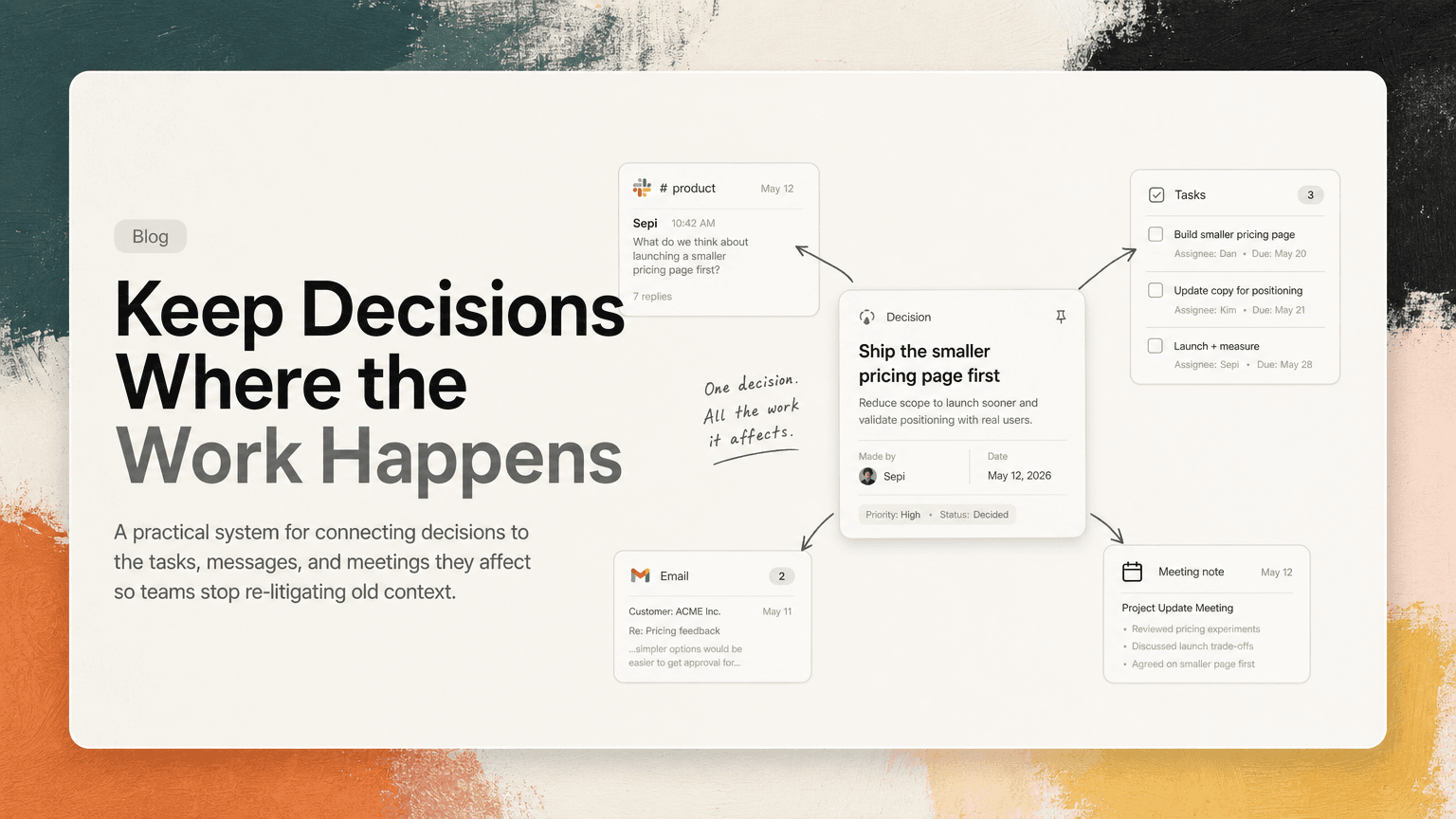
Decisions are rarely lost because nobody wrote them down. They are lost because they are written down somewhere separate from the work they change.
A product decision lives in a meeting note. The follow-up task lives in a task manager. The debate happened in Slack. The customer context is buried in Gmail. Two weeks later, someone asks why the team is building the smaller version, delaying the launch, changing the copy, or dropping a feature.
Everyone has part of the answer. Nobody has the full chain.
The practical goal is simple: keep the decision attached to the work it affects. Not in a perfect archive. Not in a beautifully formatted document nobody opens. Attached to the task, thread, project, or next action where it will matter again.
A decision without an affected task is just trivia
A useful decision changes something:
- What gets built
- Who owns the next step
- What gets deprioritized
- What is no longer being discussed
- Which customer promise changes
- Which risk the team accepts
- What needs to happen before a deadline
If a decision does not change any work, it may still be interesting, but it is not operationally important yet.
This is why many decision logs fail. They collect decisions as isolated entries:
Decision: We will ship the lightweight onboarding flow first.
That is better than nothing, but it does not answer the questions people will ask later:
- Which tasks changed because of this?
- Which previous plan is now obsolete?
- Who needs to update the launch checklist?
- Was this driven by engineering scope, customer feedback, or timing?
- Where was this discussed?
A better version connects the decision to the work:
Decision: Ship the lightweight onboarding flow first.
Changes:
- Remove custom workspace setup from the v1 launch scope.
- Update the launch checklist by Friday.
- Tell Customer Success not to promise custom setup in early pilots.
- Revisit custom setup after the first onboarding metrics review.
Source context: Product review meeting, Slack thread with Engineering, Gmail thread from Customer Success.
Now the decision is not just a note. It is a set of changed commitments.
Use the “decision → affected work” pattern
When a decision is made, capture it in two parts:
- The decision itself
- The work it changes
This sounds obvious, but most teams only capture the first half. The second half is what prevents future confusion.
Use this lightweight template:
Decision:

Why:

Affected work:
- Task/project:
- Owner:
- Deadline or review date:
- What changed:

Source context:
- Meeting/thread/email:
You do not need to make this formal. You can paste it into a meeting note, a project doc, a Slack thread, or a task description. The important part is that the affected work is explicit.
Example: a Slack decision
A Slack thread starts with a simple question:
Should we keep the advanced filters in the first release?
After 18 replies, the team agrees to cut advanced filters and ship basic search first.
Bad capture:
We decided to cut advanced filters.
Better capture:
Decision:
Cut advanced filters from the first release and ship basic search.

Why:
Engineering scope is tight, and basic search covers the immediate customer need.

Affected work:
- Remove advanced filters from Release 1 checklist.
- Add follow-up task to revisit filters after launch feedback.
- Update demo script so Sales does not mention filters as launch functionality.

Source context:
Slack thread in #product-launch on Tuesday.
The difference is not extra documentation. It is fewer future interruptions.
Put the decision in the task, not just the note
Meeting notes are useful at the moment of capture. Tasks are useful at the moment of execution.
If a decision affects a task, the task should carry the decision.
For example, imagine this task:
Update onboarding email sequence.
That is clear enough to start work, but it lacks the reason. The person doing the work may not know whether the goal is conversion, support reduction, pricing clarity, or launch timing.
A better task description:
Task:
Update onboarding email sequence.

Decision attached:
We are simplifying onboarding for launch and removing references to custom setup.

Why:
The first release should guide users into the standard setup path only. Custom setup is deferred.

Source:
Launch planning meeting, May 14. Related Gmail thread from Customer Success.
Now the executor has the context needed to make smaller decisions without reopening the larger one.
This matters most when work crosses functions. A product manager may understand the tradeoff. A designer, engineer, marketer, or customer-facing teammate may only see the task. If the task does not include the decision, they have to reconstruct it or ask again.
Treat “what changed?” as the most important question
After any meeting or long thread, do not start by asking, “What did we discuss?”
Ask:
What changed because of this?
That question turns conversation into execution.
Useful answers look like this:
- “The launch date stays the same, but the scope is smaller.”
- “Alex owns the customer follow-up instead of Priya.”
- “We are no longer waiting for the analytics dashboard before shipping.”
- “The pricing page copy needs legal review before Friday.”
- “The bug is a launch blocker, not a post-launch cleanup item.”
Each of those changes should attach to a task, owner, or project.
If nothing changed, you may not need a task. You may only need a record. That distinction matters. Teams create clutter when every discussion becomes a vague todo. They lose momentum when real changes stay trapped in discussion.
Link decisions to the source, but summarize the source
Source links are valuable, but they are not enough.
A raw link to a Slack thread or meeting transcript says, “The answer is somewhere in here.” A useful decision note says, “Here is the answer, and here is where it came from.”
Use both:
Decision:
Delay the beta invite email until the billing bug is fixed.

Why:
Inviting more users before the fix creates avoidable support load.

Affected work:
- Move beta invite email from Wednesday to next Monday.
- Add billing bug to launch blockers.
- Notify Support in the beta channel.

Source:
Billing triage meeting and Slack thread in #beta-launch.
The summary lets someone move quickly. The source lets someone verify the context when needed.
This is especially useful when decisions are sensitive or likely to be questioned later. If you are changing a deadline, cutting scope, changing a customer commitment, or reversing a previous plan, keep the source close.
Watch for duplicate decisions in different places
One of the easiest ways to lose context is to make the same decision twice in different tools.
It often looks like this:
- In a meeting, the team decides to delay a feature.
- In Slack, someone asks if the feature is still in scope.
- In Gmail, a customer-facing teammate asks what they can promise.
- In the task manager, the old task still says it is due this week.
Now the system contains multiple versions of reality.
The fix is to identify the canonical affected work. Usually that is the project, milestone, launch checklist, or task that people actually use to execute. Attach the decision there, then update or close the conflicting work.
A simple rule helps:
If a decision changes a task, update the task before you announce the decision.
That prevents the announcement from becoming another loose piece of context.
Use meetings to confirm decisions, not bury them
Meetings are where many decisions happen, but meeting notes are often too chronological. They reflect the order of conversation rather than the structure of the work.
A meeting note might say:
Discussed onboarding scope.
Engineering concerned about timeline.
CS mentioned pilot customers need setup help.
Marketing asked about launch copy.
Decided to simplify v1.
That is understandable today and vague next week.
A more useful meeting closeout is:
Decisions:
- Simplify v1 onboarding to standard setup only.
- Defer custom setup until after first pilot review.

Changed work:
- Product: update launch scope.
- Engineering: remove custom setup tasks from Release 1.
- Marketing: remove custom setup language from launch copy.
- Customer Success: update pilot messaging.

Open questions:
- When do we review custom setup again?
The closeout should happen before the meeting ends, not later when everyone has moved on. Reserve the last five minutes for decisions and changed work. If the meeting produced no decisions, say that explicitly.
Build a small daily habit
You do not need a heavy process. You need a daily habit that catches decisions before they drift away from execution.
At the end of the day, scan three places:
- Slack threads where decisions were made
- Gmail threads with customer or stakeholder commitments
- Meetings that produced action items or scope changes
For each one, ask:
- What decision was made?
- What work changed?
- Is the affected task updated?
- Is there a source link or summary?
- Did this duplicate or contradict an older task?
This review can take a few minutes if you keep it focused. Do not summarize every conversation. Only capture decisions that change work.
For people managing many streams of communication, this is where an intelligent work assistant can help. CTRL connects to the places where work already happens, such as Slack, Gmail, Calendar, meetings, and notes, and helps turn scattered decisions and follow-ups into clear next actions with relevant context attached.
The point is not to create more documentation. It is to reduce the number of times your team has to ask, “Wait, why are we doing it this way?”
A simple checklist for decision hygiene
Use this whenever a decision feels important:
- Did we state the decision in one sentence?
- Did we capture why it was made?
- Did we list the tasks, projects, or commitments it changes?
- Did we update the actual place where execution happens?
- Did we attach or summarize the source context?
- Did we remove or update any old conflicting tasks?
- Did we assign an owner for each changed action?
- Did we set a review date if the decision is temporary?
The most important item is the fourth one: update the actual place where execution happens.
A decision in a meeting note may be remembered. A decision attached to the task will be used.
Keep the chain intact
Good execution depends on a chain:
Conversation → decision → changed work → owner → next action → outcome.
Most context problems happen when that chain breaks. A decision stays in Slack. A task loses its rationale. An email promise never reaches the project plan. A meeting creates alignment but no changed work.
You do not fix this by writing longer notes. You fix it by keeping decisions close to the work they change.
When someone opens a task, they should be able to see not only what to do, but why it changed, where the decision came from, and what is no longer true.
That is the difference between a team that keeps re-litigating old context and a team that can move forward with confidence.


Make today life changing
Move from conversation to actions in seconds
Download the ^ctrl desktop app