By Ctrl Editorial Team · May 29, 2026 · 8 min read
Meeting Notes Should Not Be the Final Output
A practical guide to turning meeting notes into clear next actions before decisions, owners, and context disappear.
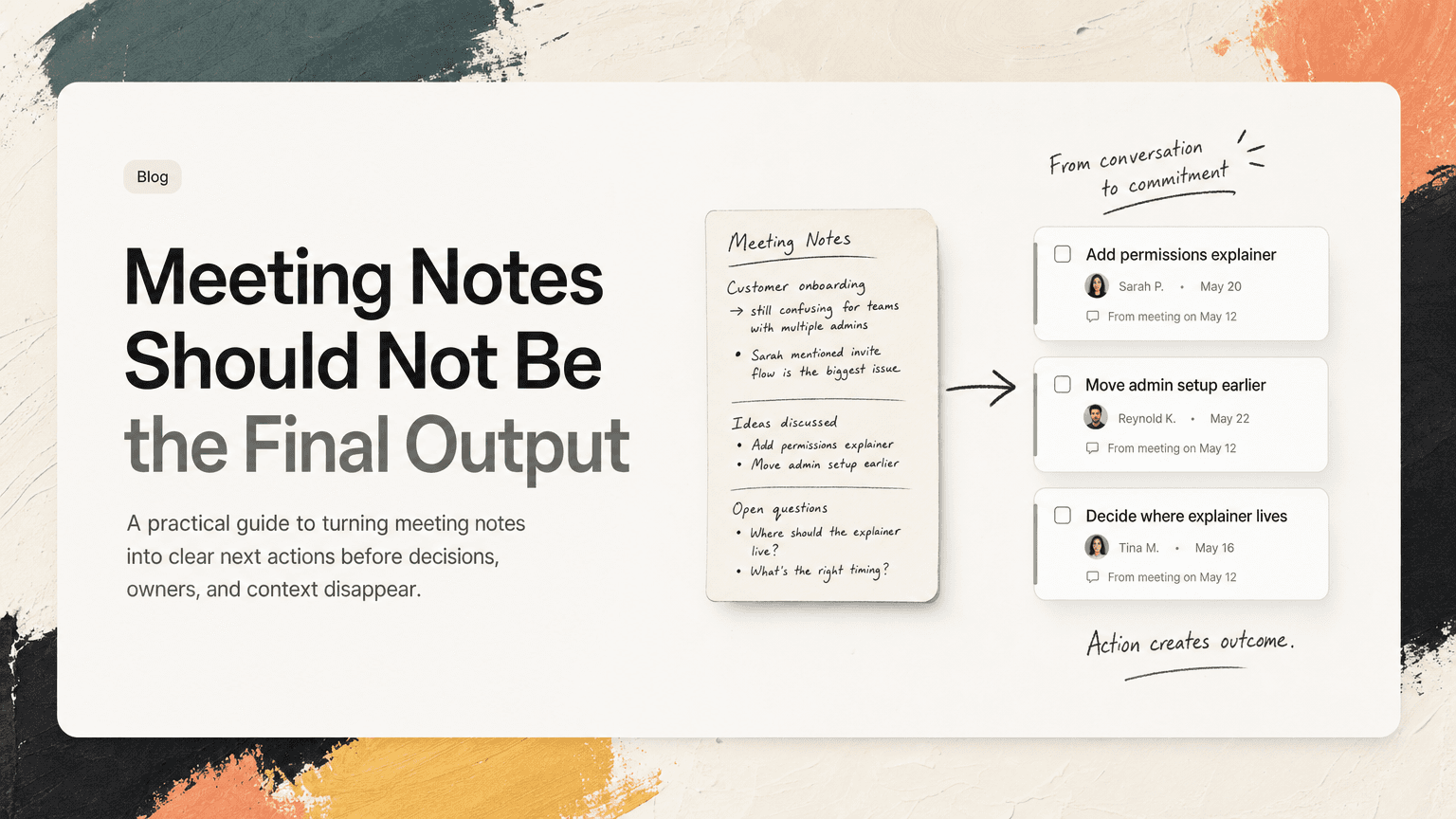
Most meeting notes are written as if remembering the conversation is the goal.
It usually is not.
The goal is to change what happens next: ship the fix, follow up with the customer, rewrite the proposal, schedule the review, unblock the engineer, decide between two options, or tell the team what changed.
A page of notes can help, but only if it becomes a set of next actions. Otherwise it becomes one more place where work is technically documented but practically invisible.
The problem is not that people are bad at taking notes. The problem is that notes and execution are different artifacts. Notes preserve what was said. Next actions define what someone will do.
If your meetings end with notes but no action system, the meeting is not really over. The work has just been deferred to someone’s memory.
Notes capture conversation. Actions create commitment.
A useful note might say:
Customer onboarding is still confusing for teams with multiple admins. Sarah mentioned that the invite flow is the biggest issue. We discussed adding a permissions explainer and moving admin setup earlier.
That is good context. It records the discussion.
But it does not tell anyone what happens next.
A next action looks different:
Maya to draft a revised admin invite flow by Thursday, using Sarah’s customer examples from the onboarding call.
Now the work has shape:
- Owner: Maya
- Verb: draft
- Object: revised admin invite flow
- Deadline: Thursday
- Context: Sarah’s customer examples from the onboarding call
That difference matters. The first version helps people remember. The second version helps people execute.
Teams often confuse the two because meeting notes feel productive. They create a record. They make the meeting seem less ephemeral. But if nobody extracts the actions, the notes become a searchable archive of unfinished intent.
The failure mode: vague notes that require interpretation later
The worst meeting notes are not useless. They are almost useful.
They contain lines like:
- “Need to revisit pricing page.”
- “Follow up with Legal.”
- “Engineering to check feasibility.”
- “Discuss rollout plan.”
- “Customer wants update next week.”
Each line contains work, but not enough work definition.
Later, someone has to interpret it:
- Who is revisiting the pricing page?
- What exactly needs to change?
- Who owns the Legal follow-up?
- What question should Engineering answer?
- Which customer wants an update?
- What does “next week” mean?
This creates a second meeting inside someone’s head. They reopen the doc, scan Slack, search Gmail, check the calendar invite, and reconstruct what the group probably meant.
That is context switching disguised as follow-through.
The fix is to convert notes into next actions while the context is still fresh.
Convert decisions, questions, and risks into action types
You do not need to turn every sentence into a task. Most notes should stay notes.
Focus on the parts that imply future work. They usually fall into a few categories.
1. Decisions that require communication
A decision is not complete just because five people agreed in a meeting.
If other people need to know, the next action is communication.
Note:
We agreed to delay the beta launch by one week.
Next action:
Priya to post the updated beta launch date in the product channel and notify the customer-facing team by end of day.
This prevents the classic problem where a decision exists in meeting notes but not in the places where people actually coordinate.
2. Questions that require an answer
Unanswered questions should not remain as bullet points forever.
Note:
Not sure whether Gmail sync should include archived threads.
Next action:
Alex to confirm expected Gmail archive behavior with Engineering and bring recommendation to Friday planning.
The action is not “figure out Gmail.” It is a specific investigation with a destination.
3. Risks that require mitigation
Risks are easy to document and easy to ignore.
Note:
Sales team may not have enough context before the pricing announcement.
Next action:
Jordan to prepare a one-page pricing FAQ for Sales before Wednesday’s team meeting.
Now the risk has a countermeasure.
4. Ideas that require selection
Brainstorming creates many possible tasks. Do not add them all.
Note:
Ideas: new onboarding checklist, admin setup video, sample workspace, better invite copy.
Next action:
Nina to pick the top two onboarding experiments for next sprint and share rationale in the planning doc by Tuesday.
The action is not to execute every idea. It is to make the next decision.
5. Follow-ups that require external movement
Many meeting outcomes involve someone outside the room.
Note:
Need customer feedback on proposed workflow.
Next action:
Sam to email Acme and Northstar asking for feedback on the proposed workflow by Thursday, linking the latest mockup.
This is where Gmail follow-ups often disappear. If the note never becomes a task, the email depends on memory.
Use a simple next-action format
A good next action should be boringly clear.
Use this structure:
Owner + verb + outcome + deadline + context
For example:
Lena to summarize the launch decision in Slack by 3pm, including the reason we are cutting the reporting feature from v1.
This works because it removes ambiguity.
- Owner: Lena
- Verb: summarize
- Outcome: launch decision shared
- Deadline: 3pm
- Context: reason for cutting reporting from v1
The context is important. A task without context is a future interruption.
If Lena only sees “Post launch decision,” she may need to reopen the meeting notes, ask someone what changed, or search Slack for the feature discussion. If the reason is attached, she can act without reassembling the whole conversation.
Do the conversion before the meeting fully ends
The best time to create next actions is during the last five minutes of the meeting.
Not after lunch. Not tomorrow morning. Not when someone finally cleans up the doc.
End with a short action review:
- What did we decide?
- What needs to happen next?
- Who owns each action?
- When is it due?
- Where is the source context?
This does not need to be dramatic. It can be a small closing ritual.
For a product review, the final five minutes might produce:
- Emma to update the onboarding copy in the mockup by Thursday.
- Ravi to confirm whether the permissions edge case affects existing workspaces before sprint planning.
- Dana to post the launch timing decision in Slack today.
- Chris to email the design partner with the revised rollout plan by Friday.
That is far more useful than a long notes doc with an “Action items” section nobody trusts.
Keep source context attached to the task
A next action should not be detached from the conversation that created it.
When possible, attach the source:
- the meeting note section
- the calendar event
- the Slack thread where the issue started
- the Gmail thread with the customer request
- the shared doc with the decision rationale
This matters because tasks often outlive memory.
A task like “Follow up with customer about admin setup” may be obvious today. In four days, it is vague. Which customer? What admin issue? What did we promise? Who was on the call?
A source-linked action prevents unnecessary digging. It also reduces duplicate follow-ups. If the same action appears in the meeting notes, Slack recap, and a Gmail thread, the team should not create three separate tasks that all mean the same thing.
This is one reason tools like CTRL are useful: the work is already scattered across meetings, Slack, Gmail, and notes, so the task system needs to understand where the action came from, not just store a copied sentence.
Separate records from commitments
You still need notes. Do not turn every meeting into a task extraction machine with no memory of the discussion.
But keep a clean distinction:
- Notes are the record.
- Tasks are the commitments.
- Decisions are the rationale that explains why the commitments exist.
A healthy meeting artifact might look like this:
Decisions
- We will delay beta launch by one week to finish admin onboarding fixes.
- Reporting exports stay out of v1.
Context
- Customer-facing teams need updated messaging before outreach.
- Two design partners specifically asked about admin invites.
Next actions
- Priya to announce the new beta date in Slack today.
- Maya to revise the admin invite flow by Thursday.
- Jordan to draft Sales FAQ before Wednesday’s team meeting.
- Sam to email design partners with the revised rollout plan by Friday.
This structure lets someone scan the page and immediately understand what changed, why it changed, and who is doing what.
Watch for hidden actions in polite language
Meeting notes often hide work behind soft phrasing.
Look for phrases like:
- “We should…”
- “It would be good to…”
- “Someone needs to…”
- “Let’s make sure…”
- “Can we check…”
- “Worth exploring…”
- “Need clarity on…”
These phrases are not bad. They are signals.
Each one should either become a next action or be deliberately ignored.
For example:
“We should make sure Support knows about the change.”
Turn it into:
Tyler to send Support the release note and known limitations by tomorrow at noon.
Or decide:
No action. Support already received the update in yesterday’s enablement doc.
Both outcomes are better than leaving “make sure Support knows” in the notes as a vague obligation.
A practical post-meeting checklist
After any meaningful meeting, run this checklist before you move on:
- Did every action have one owner?
- Does each action start with a concrete verb?
- Is there a deadline or review point?
- Is the relevant context attached?
- Are duplicate actions merged?
- Were decisions shared where the affected people will see them?
- Did email follow-ups become actual tasks, not just good intentions?
- Did Slack updates get assigned to a person, not “the team”?
If the answer is no, the meeting is still leaking work.
The point is not better notes. It is less rework.
When meeting notes do not become next actions, the cost shows up later as repeated clarification, missed follow-ups, stale tasks, and people searching across tools to understand what they owe.
The solution is not to write longer notes. It is to create a tighter handoff from conversation to execution.
Capture the decision. Name the owner. Define the action. Attach the context. Put it where work is actually tracked.
CTRL can help with this by turning scattered meeting, Slack, and email context into clearer next actions, but the underlying habit is tool-independent: do not let the meeting end at documentation.
A meeting creates value only when something changes afterward. Notes are the memory. Next actions are the mechanism.


Make today life changing
Move from conversation to actions in seconds
Download the ^ctrl desktop app